Lurcy-le-Bourg, one of the oldest parishes in Nivernais, which has been traced back to the sixth century, is located in the heart of Montenegro, shaped by centuries of feudal and rural life. The village was a châtellenie de Montenoison, whose fiefs, parishes and customs formed a coherent whole. As early as the 13th century, Lurcy became the ecclesial center of this country: the seat of an archpriested church of forty-seven parishes, the place of formation of the clergy and the point of collection of tithes. In the 16th century, the country reached its peak and, despite the tensions of the Wars of Religion, the archiprired maintained strong religious cohesion, limiting ruptures.
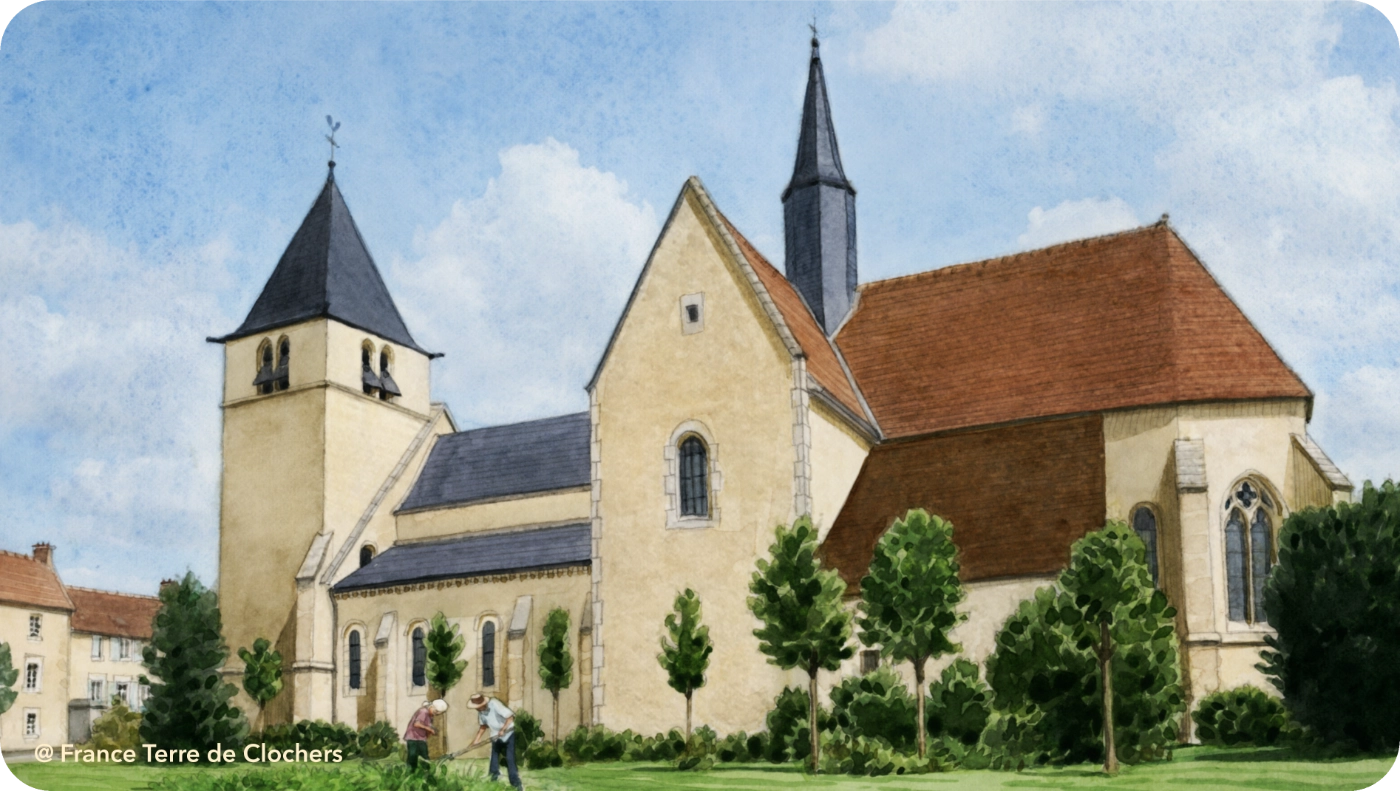
The Saint-Gervais-Saint-Protais church is the former church of a Benedictine priory founded at the end of the 11th century, reporting directly to Cluny. Probably built in the early 12th century, it rises on the basis of a sixth century oratory, showing remarkable Christian continuity. The building preserves the cruciform Romanesque nucleus: arched transept in cradle, crossed in warheads, vaulted choir in cradle, lower sides in ridges and apsidioles in the middle of the hangar. The Romanesque capitals, of great finesse, represent animals confronted, crosses, foliages and vine pampres. The western portal keeps a primitive bas-relief: a mystical Lamb under a blessing hand, rare and powerful motif. The buildings of the priory, including the prior's house, built around 1400, also remain. In 1846, heavy rain caused a flood of the Loire: a hole pierced the roof and the nave was flooded up to a metre, still visible today.
The church depends on the parish of Sainte-Bernadette in Nivernais, which is part of the diocese of Nevers. Masses in Lurcy‐le‐Bourg are published in the parish calendar. The term Saint-Gervais-Saint-Protais is extremely old in France. It is often found in churches founded before the year Mil, linked to priories, located in ancient rural areas. Protected since 2019, the church is currently under maintenance.