


The church of Saint Andrew de Montbolo, perched at the top of this village of Vallespir, is one of the most emblematic examples of Catalan Romanesque architecture. Mentioned as early as 993, it was consecrated in 1130 and is distinguished by its twin apse plan, rare in the region. Its location on a promontory overlooking the valley of Tech, open on the plain of Roussillon and the Mediterranean, makes it a true symbol of the Roussillon heritage. From its parvis, the view of the Canigó, located 15 km from the bird's flight and culminating at 2,784 m, is spectacular, with no relief obstructing the silhouette.
In the 14th century, the church was fortified: high dropural walls to create a round path, murderous, and barlong towers at the east and west ends, giving it its massive and protective look. The interior preserves a furniture classified as a Historical Monument: a 12th century Virgin with a Child, a 15th century bell, as well as a ciborium, a chalice and a procession cross from the 17th–15th centuries. More recently, emergency work has involved the stair lintel, and a preliminary study has been initiated after cracks in the nave vault. The church belongs to the diocese of Perpignan-Elne and the parish of Vallespir centered on Amélie-les-Bains-Palalda.
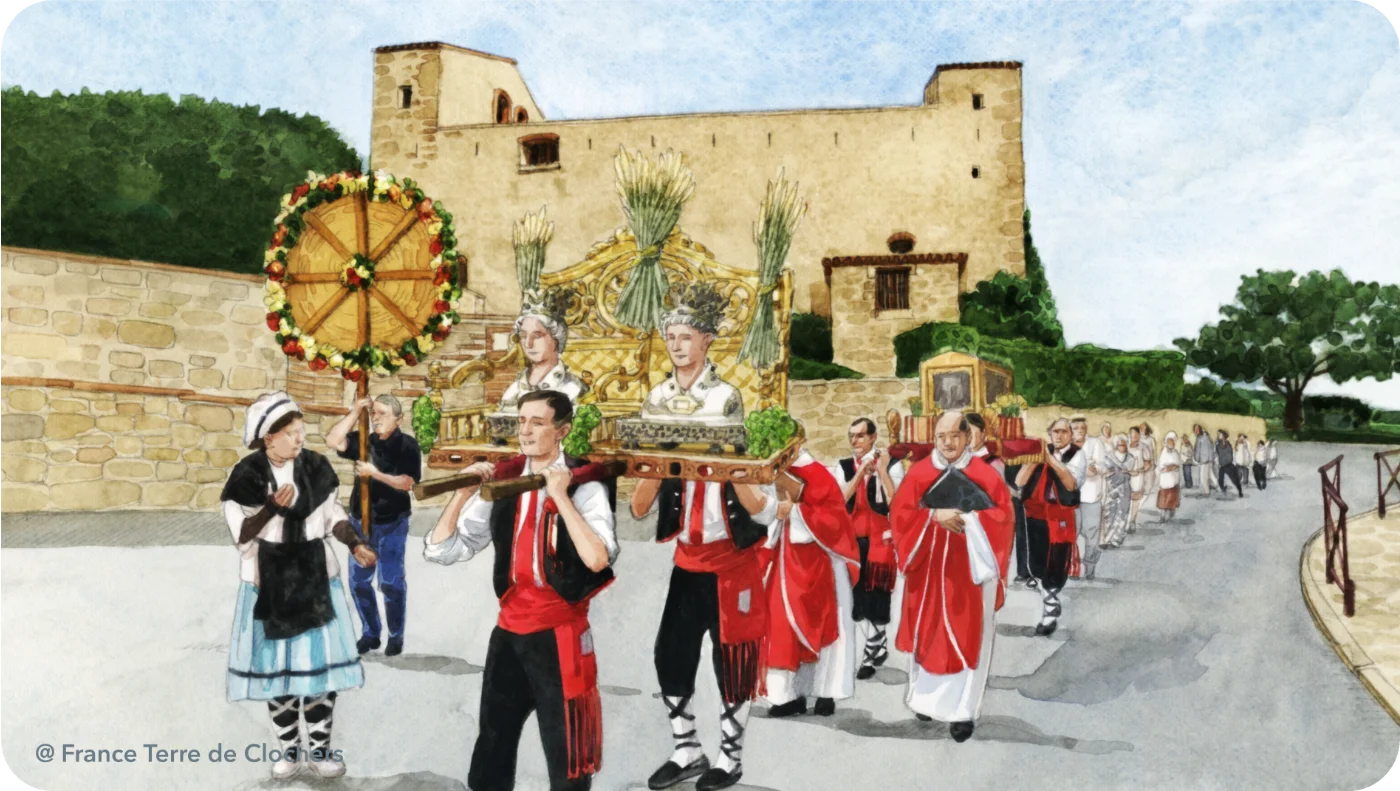
The religious history of Montbolo is part of that of Vallespir, christianized very early and marked by the influence of Benedictine abbey Saint Mary of Arles-sur-Tech, guardian of the relics of Saints Abdon and Sennen. From this connection was born the tradition of the Rodella, a votive ritual attested since 1465: every 30 July, a large spiral candle, made in Montbolo, is carried in procession to Arles-sur-Tech in homage to the patron saints of the valley. This tradition, still alive, embodies the religious and Catalan identity of Montbolo, a village perched by its rituals, its language and the landscapes of Vallespir.