



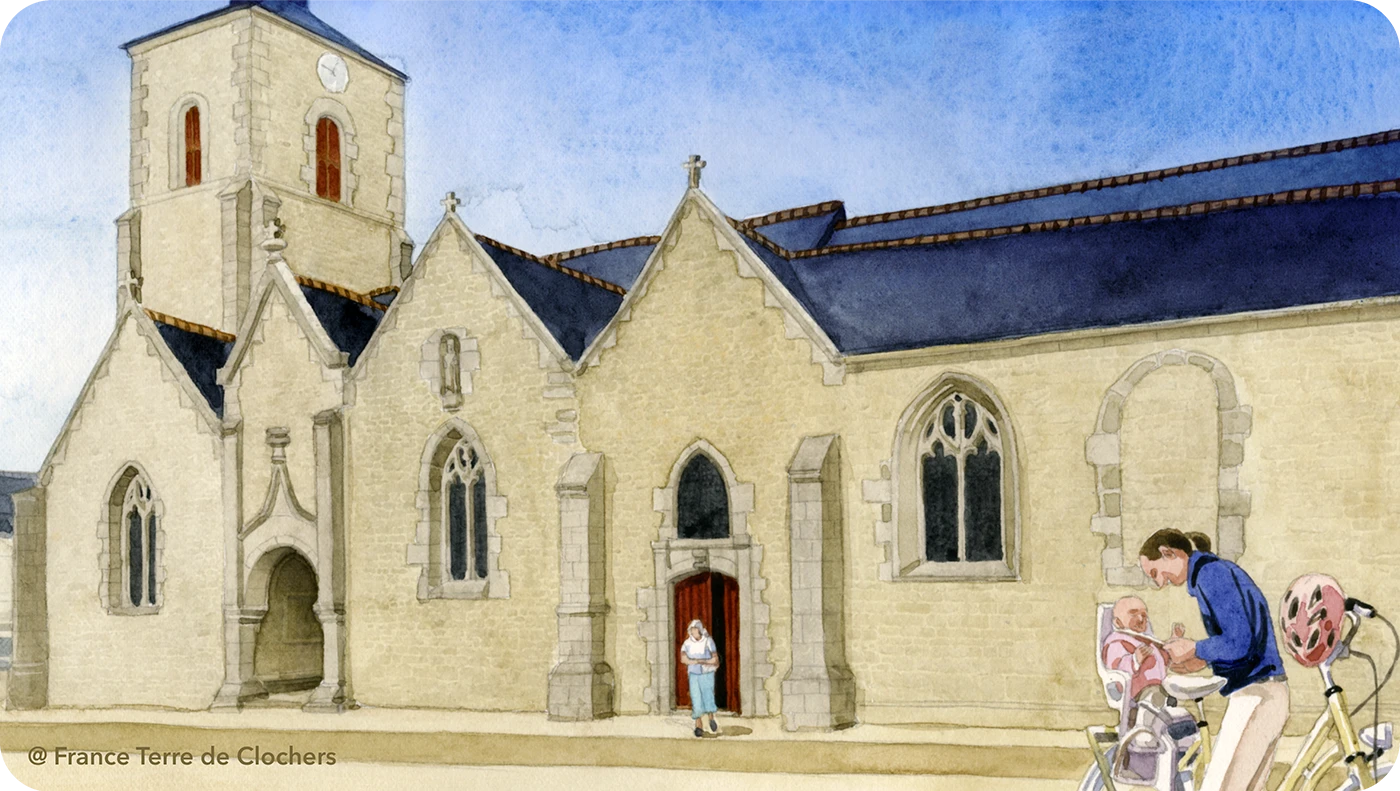
Located in the heart of the Vannetese Country, the church Saint-Thuriau de Berric is part of a very ancient religious history, in a Christianized region very early. The erection of the parish could date back to the end of the tenth century, shortly after the expulsion of the Normans.
Placed under the patronage of Saint Thuriau, bishop of Dol, who died around 640, it is in the moorland area of Questembert, which was previously the scene of the victory of Alain I over the Vikings in 888. Tradition attributes its construction to the Templars, making Saint-Thuriau one of the few Breton buildings of this order in the 12th century. The church then adopts a form of Latin cross. In the 13th century appeared Guillaume de Berric, the first lord of the place.
In 1476, the roof was rebuilt, as evidenced by a sandstone of the southern transept bearing the date in Gothic letters, one of the oldest restorations known for the building. The choir was retouched in 1639 and then painted in 1645, bringing a warm interior atmosphere. In 1660, the south arm of the transept was extended along the nave, giving the church its present silhouette with a low side. In 1925, the bell tower was rebuilt.
The church of Saint-Thuriau belongs to the parish complex of Berric, where a Sunday Mass is celebrated alternately with Lauzach. It is also part of the heritage circuits of Rochefort-en-Terre and Morbihan, demonstrating its importance in the Breton landscape.