



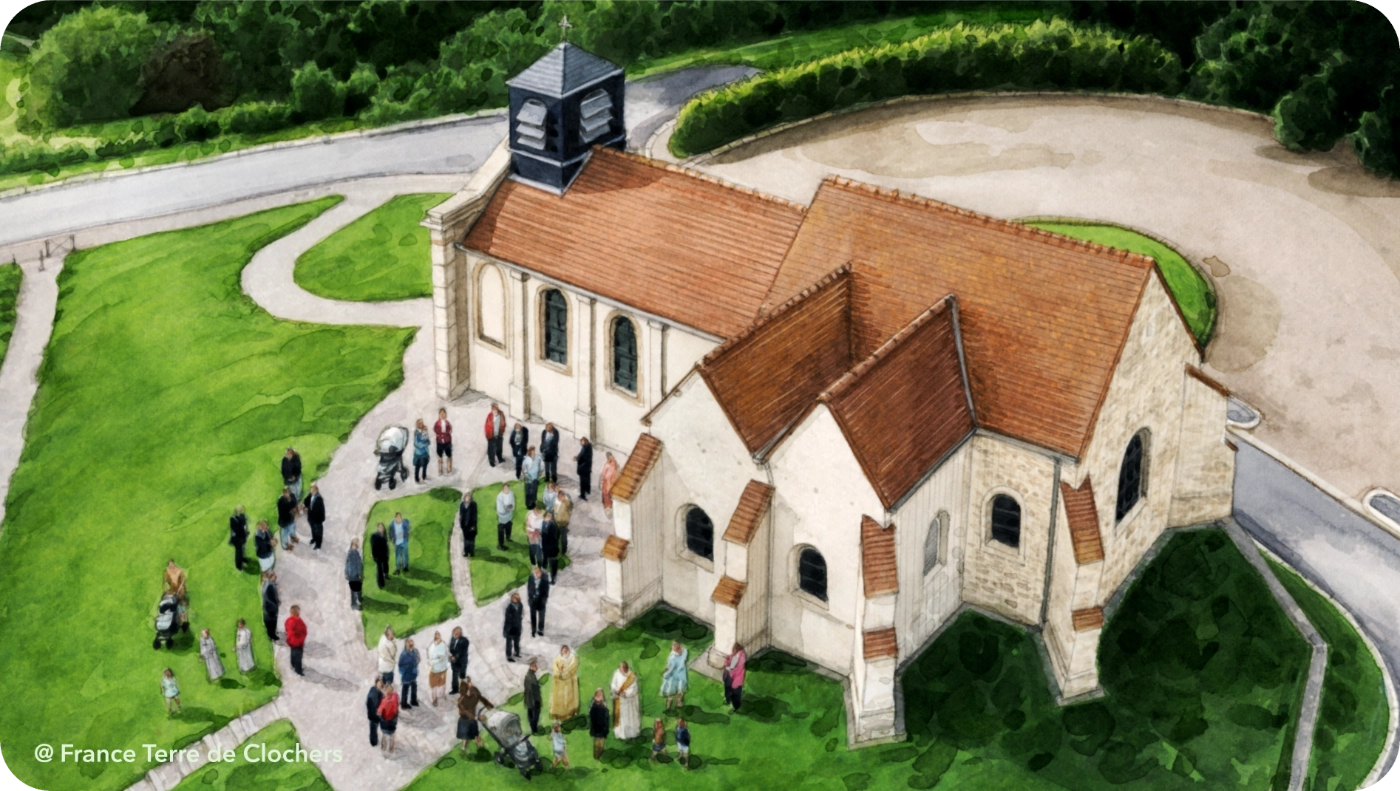
The Seine is a very ancient human occupation axis. In this part of the humid Champagne, it is bordered by slightly raised terraces which, from antiquity and the early Middle Ages, favored the establishment of hamlets of passage and mower. Pars‐lès‐Romilly is located precisely on one of these areas where the marshes could be crossed or bypassed. The village historically belonged to Champagne and depended on the lords of Romilly in the Middle Ages, then on the seigneury of Pont-sur-Seine. In the 18th century the village of Pars‐lès‐Romilly was named after Pars-en-Champagne. The village's resources came mainly from its marshes: highly sought after marsh hay, seasonal pastures, reeds, fishing and water management. The village depended on the mills of Romilly and Pont-sur-Seine, which structured local hydrology.
The Saint-Martin church of Pars‐lès‐Romilly is located on an ancient tumulus, once surrounded by a cemetery, suggesting a medieval funeral occupation The term Saint-Martin refers to an ancient rural parish. The church preserves from the medieval building a 14th century tumular stone, now fragmented in six pieces and deposited in the nave. This slab represents the face of a woman under a gothic dais and bears the epitaph of Nicholas' mother, parish priest, who died on 11 Feb. 1326. This vestige attests to the existence of a parish formed in Pars from the beginning of the 14th century. The present church results mainly from the transformations of the 16th century, during which the sanctuary, the choir, the southern side chapel and the flat bedside abside were rebuilt. These elements now form the architectural core of the building. The oldest window, located in the choir, also dates from this period. In 1780 the reconstruction of the ceiling nave took place, as indicated by an inscription near the small door.
The church belongs to the Parish Ensemble of Romilly-sur-Seine, which belongs to the diocese of Troyes. The Church of St.Martin benefits from periodic Sunday Masses and even weekly Masses.
The current work concerns the restoration of the south-east gable of the south arm of the transept.


