



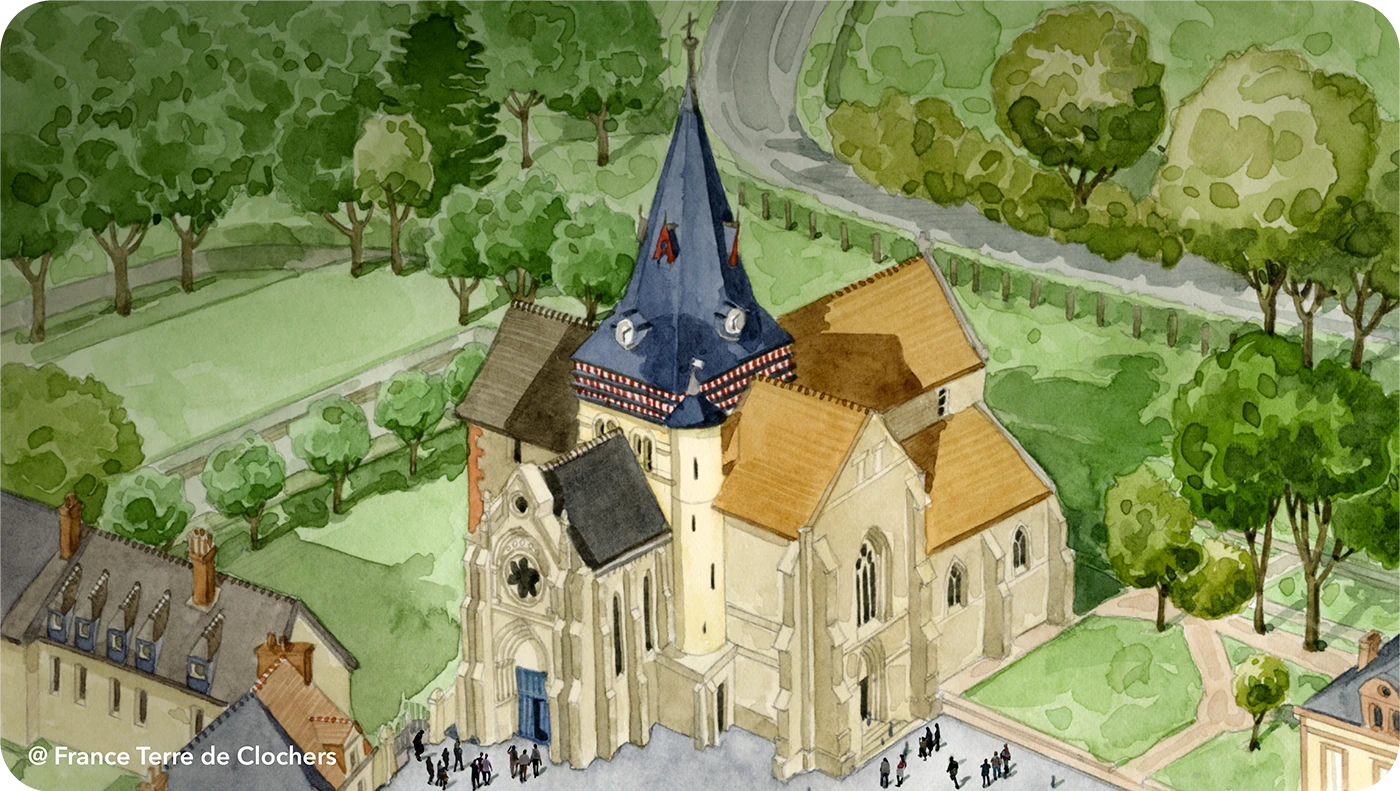
The Saint-Sauveur church in Beaumont-en-Auge is one of the major religious buildings in the Pays d'Auge. Founded in the 11th century under William the Conqueror, it belonged to the Benedictine priory dependent on Saint-Ouen Abbey of Rouen. Its history is read in a superimposition of styles: rare Carolingian tower-lantern in Normandy, 11th century Romanesque arcades and columns, Gothic additions around 1100 and then flamboyant in the 15th and 16th centuries, with apsides, crosses, rosace and flat bedside pierced by a large bay. In the 15th century, the early tower received a scarlet half-timbered bell tower and a frame arrow, while the choir adopted a three-level structure — large arcade, triforium and high windows. The nave, largely destroyed, retained only one span, rebuilt in the 19th century in a neo-Gothic style.
The church remains a rare witness of sacred Romanesque art in Auge Country, enriched with Gothic and flamboyant strata illustrating the evolution of religious architecture in Normandy from the 9th to the 19th century. It embodies both Carolingian memory and medieval monastic power.
Beaumont-en-Auge was a place of pilgrimage from the ninth century, and there was a devotion to the Saint-Sauveur. Today, the church of Saint-Sauveur is part of the diocese of Bayeux-Lisieux and is part of the parish of Notre-Dame de la Côte Fleurie. It hosts Sunday Mass, pilgrimages and an immersion with Gregorian chants. The church remains accessible daily from 10 a.m. to 7 p.m. A campaign to restore the nave covers is underway to ensure the transmission of this exceptional heritage.