



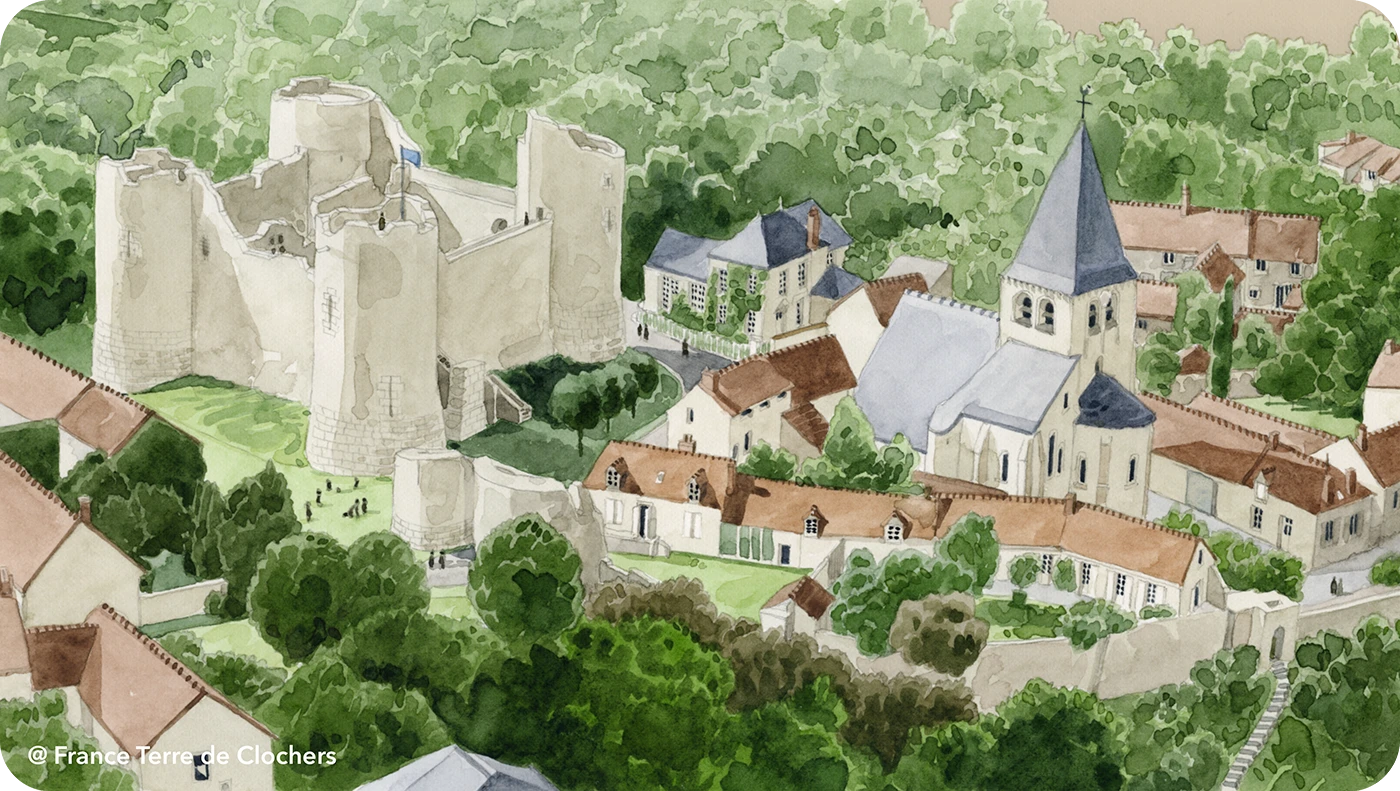
In the heart of the medieval village of Yèvre-le-Châtel, the only village in the Loiret classified among the most beautiful villages in France, the church of Saint-Gault occupies a singular place. Built in the 11th century in a Romanesque style, it is located in the lower courtyard of the 13th century castle, within a remarkable ensemble comprising ramparts, flowery venals and the nearby church Saint-Lubin. Registered as a Historic Monument since 1925, it contributes to the charm of the site, which attracts more than 100,000 visitors a year. Its unique nave, its cul-de-four choir and the Gothic additions of the 13th century testify to the evolution of a initially modest building, which became a place of Christian worship radiating far beyond the village.
The history of Saint-Gault is closely linked to the castle and the local religious tradition. Monks from Brittany would have brought the relics of the saint, creating in the eleventh century the foundation by Lucinde, wife of Baron Arnoul de Yèvre, of an abbey within the enclosure of the castle. In 1112, Louis VI the Big made Yèvre-le-Châtel a powerful chestnut, reinforcing the strategic and religious importance of the place. Between the 11th and 12th centuries the Castral Chapel became a parish church. It then became the religious heart of the expanding village.
Dominating the landscape, the castle and the church today form an inseparable whole. Dedicated to Saint-Gault, a local saint venerated throughout Pithiver, the church is part of the diocese of Orléans and is part of the parish of Pithiverais. Masses are punctual. The building is currently undergoing interior restoration.